Union County Dog Registration Information
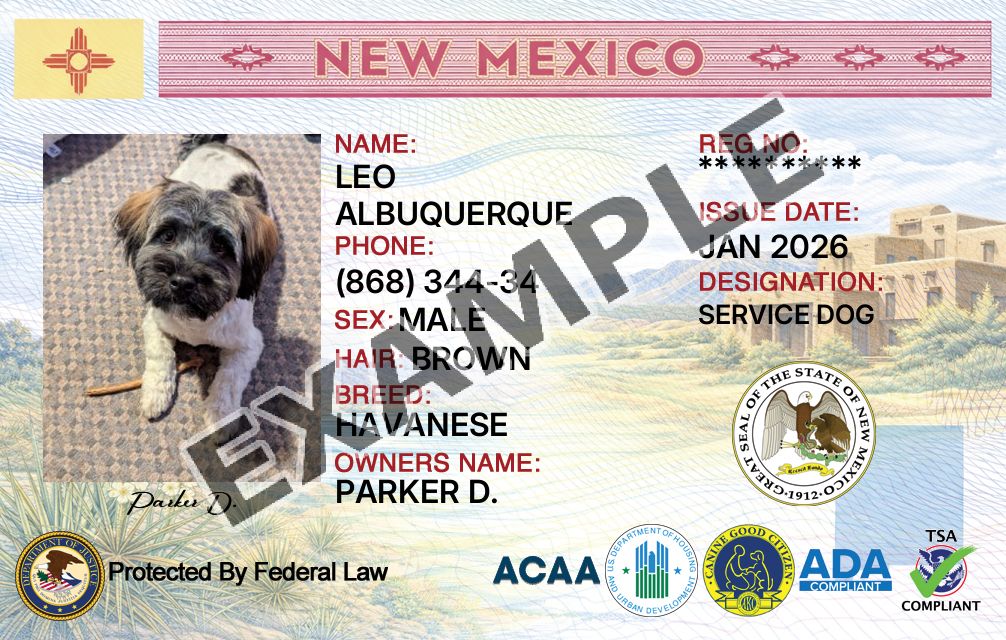
Service Dogs and Emotional Support Animals in Union, New Mexico
Registering Your Dog in Union County, New Mexico (Service Dog or Emotional Support Dog)
If you’re searching where do I register my dog in Union County, New Mexico for my service dog or emotional support dog, the most important thing to know is that there usually isn’t a single statewide “service dog registration” system. In practice, what most residents need is a dog license in Union County, New Mexico (or a town license), plus proof their dog meets local public health requirements (especially rabies vaccination). Service dogs and emotional support animals (ESAs) are handled under different legal rules than licensing—and the steps can vary depending on whether you live inside the Town of Clayton or in unincorporated Union County.
Where to Register or License Your Dog in Union County, New Mexico
Because licensing is often handled at the county or city level, here are several official, local offices within Union County, New Mexico that residents commonly contact for dog licensing direction, animal control questions, and rabies-related public health guidance. If you live in the Town of Clayton, Clayton’s municipal animal ordinance includes a licensing requirement for dogs and cats. If you live outside town limits, start by calling an official county office to be routed to the correct local enforcement or animal control contact.
Example Official Offices (Union County area)
| Office | Address | Phone | Office Hours | |
|---|---|---|---|---|
| Union County Clerk’s Office (Union County Administration Building) |
200 Court Street Clayton, NM 88415 |
575-374-9491 ext 2 |
devian.fields@unionnm.us kim.mitchell@unionnm.us |
Not listed (call to confirm) |
| Union County Manager’s Office (Union County Administration Building) |
200 Court Street Clayton, NM 88415 |
575-374-8896 ext 4 | Luis.delacruz@unionnm.us | Not listed (call to confirm) |
| New Mexico Department of Health – Union County Public Health Office |
100 Court Street Clayton, NM 88415 |
575-374-8394 | Not listed |
Every Tuesday 10:00am–2:30pm (Closed 12:00pm–1:00pm) Weather permitting; call to verify |
| Town of Clayton (Municipal offices) | Not listed (call to confirm) | 575-374-8331 | Not listed | Not listed (call to confirm) |
Overview of Dog Licensing in Union County, New Mexico
What “registering” usually means
When people ask where to register a dog in Union County, New Mexico, they’re usually referring to a local dog license (sometimes called a pet license) issued by a municipality. Licensing is a local compliance tool: it links a dog to an owner, confirms rabies vaccination status, and supports animal control and public health response after bites or exposure incidents.
Clayton has a municipal license requirement
If you live inside the Town of Clayton, the municipal animal ordinance states that every keeper of a dog or cat 3 months of age or older must procure a license, and licensing requires proof of rabies vaccination. The ordinance also describes that a numbered certificate is issued with the owner’s information and the rabies tag number, and that license and rabies tags should be affixed to the animal (with certain exceptions). In Clayton, guide dogs are licensed without a license fee under the town’s rules.
If you live outside town limits
In many New Mexico counties, pet licensing is handled by incorporated towns/cities, while unincorporated areas may focus more on rabies compliance and nuisance/running-at-large enforcement. That’s why your first step is identifying whether your residence is within Clayton town limits or in unincorporated Union County—then confirming the correct licensing authority by phone.
How Dog Licensing Works Locally in Union County, New Mexico
Step 1: Confirm your jurisdiction (Clayton vs. unincorporated Union County)
The process depends on where you live. If you are in Clayton, you’ll generally follow Clayton’s municipal licensing rules. If you’re outside Clayton, ask a county office to confirm which local authority (if any) issues a license for your address and who handles animal control calls in your area.
Step 2: Get rabies vaccination and keep the certificate/tag
Rabies compliance is a common baseline for licensing. Under Clayton’s ordinance, a veterinarian who vaccinates a dog or cat issues a numbered rabies vaccination certificate and tag, and the owner must be able to show the certificate upon demand by an enforcement official. Clayton’s ordinance describes annual vaccination and includes a 10-day confinement/observation period rule for dogs or cats that bite a person (with certain conditions).
Step 3: Apply for a local license (if required where you live)
For Clayton residents, the ordinance describes an annual licensing cycle and requires proof of rabies vaccination before a license is issued. The town issues a numbered certificate listing the owner’s name/address, rabies tag number, and the animal’s description. A replacement license tag may be available if the original is lost.
Step 4: Keep tags and documents accessible
Even when a dog is a service dog, it still must comply with local public health requirements such as rabies vaccination. A practical approach is to keep a photo of your dog’s rabies certificate and license information (if applicable) on your phone, and keep tags on the dog’s collar/harness when appropriate.
Service Dog Laws in Union County, New Mexico
A service dog is not “made official” by a registry
Service dogs are recognized because of what they do: they are trained to perform specific tasks for a person with a disability. There is no universal government-issued “service dog registration” that you must buy to have a legitimate service dog. Be cautious about websites selling “registrations,” “certifications,” or “ID cards”—those are not the same thing as legal status.
Licensing and vaccination still apply
Local licensing rules (like Clayton’s municipal licensing requirement) can apply to service dogs. Clayton’s ordinance specifically addresses guide dogs (a type of service dog) and indicates they must be vaccinated and licensed, while also stating the town charges no license fee for licensing guide dogs.
What businesses and the public can usually ask
In many situations, the key question isn’t “Where do I register my service dog?” but “How do I comply with local health and licensing rules?” A service dog handler is typically not required to present a purchased registration card to enter public places; however, local health rules like rabies vaccination can still be enforceable. If you’re unsure, confirm with your local office and keep your rabies documentation current.
Emotional Support Animal Rules in Union County, New Mexico
ESAs are different from service dogs
An emotional support animal (ESA) provides comfort by its presence, but it is not the same as a task-trained service dog. That difference matters because ESAs do not automatically receive the same public-access rights as service dogs. In everyday life, an ESA is still subject to the same local animal rules as other pets—leash/running-at-large rules, nuisance rules, and any local dog license in Union County, New Mexico requirements that apply to where you live.
Housing-related documentation is not “licensing”
Many people who search where do I register my dog in Union County, New Mexico for my service dog or emotional support dog are really trying to solve a housing issue. For housing, what matters is generally legitimate documentation (for example, from a qualified healthcare provider) supporting the need for an ESA as a disability-related accommodation. That is separate from local licensing.
Even with an ESA letter, keep rabies proof current
Whether your dog is a pet, ESA, or service dog, rabies vaccination and local licensing rules can still apply. A landlord may also require reasonable proof that the animal complies with local vaccination requirements (while still following applicable fair housing rules).
Frequently Asked Questions
- Dog license: A local government record (often municipal) that identifies the owner/animal and typically ties to rabies vaccination compliance.
- Service dog: A dog trained to perform specific tasks for a person with a disability; legal status is based on training and function—not a purchased online registration.
- Emotional support animal (ESA): An animal that provides comfort by presence; typically relevant to housing accommodations, but it does not automatically receive the same public-access rights as a service dog.
Disclaimer
Licensing requirements and office locations may change. Residents should verify details with their local animal services office within Union County, New Mexico.
Register A Dog In Other New Mexico Counties
Select your county below to get started with your dog’s ID card. Requirements and license designs may vary by county, so choose your location to see the correct options and complete your pup’s registration.
- Bernalillo County Dog Registration
- Catron County Dog Registration
- Chaves County Dog Registration
- Cibola County Dog Registration
- Colfax County Dog Registration
- Curry County Dog Registration
- De Baca County Dog Registration
- Doña Ana County Dog Registration
- Eddy County Dog Registration
- Grant County Dog Registration
- Guadalupe County Dog Registration
- Harding County Dog Registration
- Hidalgo County Dog Registration
- Lea County Dog Registration
- Lincoln County Dog Registration
- Los Alamos County Dog Registration
- Luna County Dog Registration
- McKinley County Dog Registration
- Mora County Dog Registration
- Otero County Dog Registration
- Quay County Dog Registration
- Rio Arriba County Dog Registration
- Roosevelt County Dog Registration
- San Juan County Dog Registration
- San Miguel County Dog Registration
- Sandoval County Dog Registration
- Santa Fe County Dog Registration
- Sierra County Dog Registration
- Socorro County Dog Registration
- Taos County Dog Registration
- Torrance County Dog Registration
- Valencia County Dog Registration